
In January of this year, one of my wealthier clients did what many would have called extreme: he rotated out of gold and went all‑in on silver.
At the time, his gold had already enjoyed a powerful multi‑year run. Silver, by contrast, was still viewed by many as “the poor man’s gold” — a volatile, industrial metal that lagged its shiny cousin.
Fast forward to today, and that same client is sitting on extraordinary unrealized gains. If the fundamental drivers continue to play out, his January move could end up being remembered as one of the most prescient portfolio shifts of the 2020s.
I don’t write this to brag. I write it to highlight a simple truth that I’ve seen play out over my 16+ years in the precious metals space: when the fundamentals, technicals, and sentiment finally align in silver, the moves can be explosive. Put simply: if the precious‑metals complex moves 10%, silver might move 15–20% in the same direction. That’s what “high beta” looks like in practice.
This article is written for two groups:
I founded Your Gold Coach for one core reason: to help investors navigate the noise and build portfolios that can withstand monetary, geopolitical, and systemic risk.
My background isn’t just theory. I’ve been formally in the precious metals space for over 16 years, including:
Through all of that, one lesson has been consistent: gold is the anchor, but silver is the rocket fuel. When gold moves 1%, silver usually moves 3%.
Silver is unique: It is a monetary metal, like gold, with a long history as money and a store of value. It is also an industrial metal, critical to solar panels, electronics, EVs, 5G infrastructure, and emerging AI hardware.
That dual nature creates a powerful dynamic when investors seek safety, silver benefits from its monetary premium. When industry grows, silver benefits from inelastic demand. When both happen at once, as they are now, silver can reprice violently to the upside.
Key fundamental pillars today:
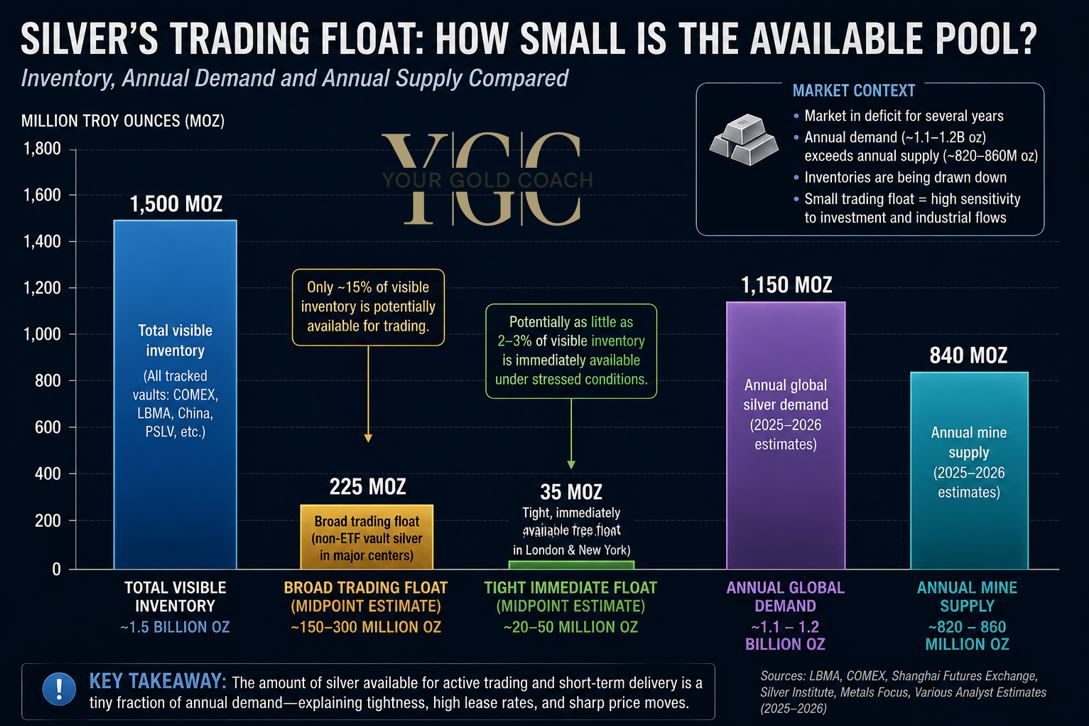
One of the cleanest ways to think about scarcity is the stock‑to‑flow (S2F) ratio:
S2F=Above‑ground stockAnnual mine productionS2F=Above‑ground stockAnnual mine production
Silver’s stock-to-flow (S2F) is roughly 22, meaning it would take about 22 years of current production to double the existing stock. That’s:
What does that mean in practice? It means that silver is scarce enough to act as a monetary asset. Scarcer flow relative to stock means that even modest shifts in investment demand can move the price dramatically. With inventories already drawn down by years of supply deficits, the market has less cushion to absorb shocks.
In the context of precious metals, calling silver “high beta” versus gold means: When the metals complex moves, silver tends to move more aggressively (both up and down) than gold. In other words, silver’s stock‑to‑flow profile makes it a high‑beta, scarcity‑driven asset in a world where both scarcity and volatility are rising.
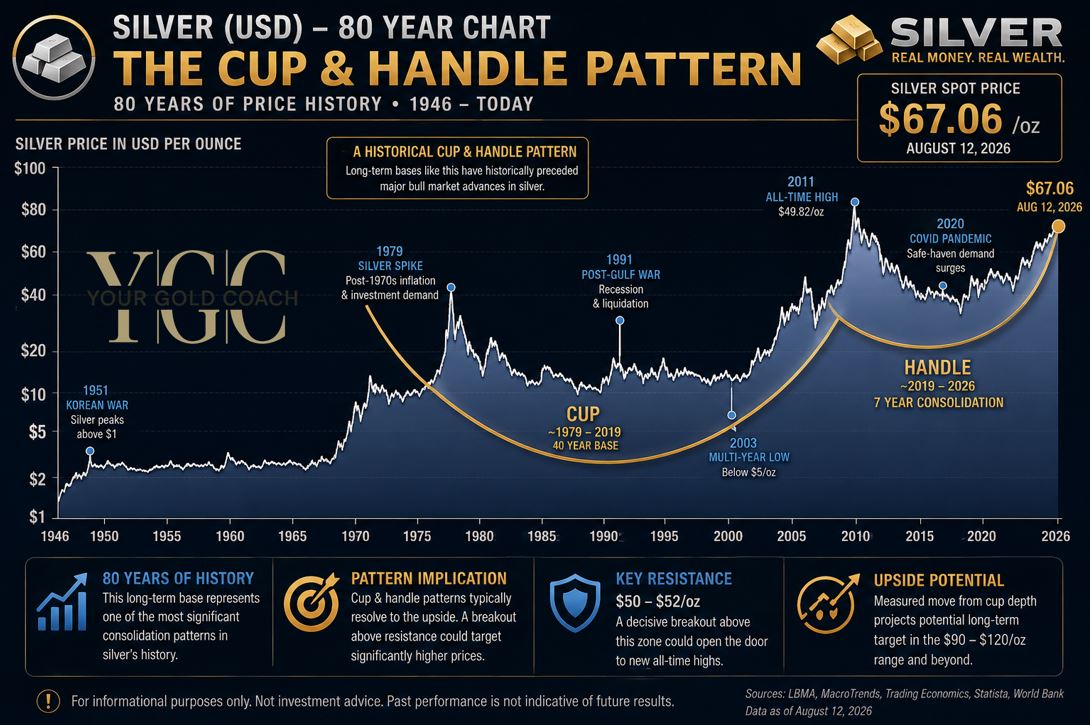
Beyond fundamentals, silver’s long‑term chart is telling an equally compelling story.
Technical analysts have been tracking a multi‑decade “cup and handle” pattern that began forming after the 1980 peak:
A cup and handle is classically interpreted as a long basing period (the cup), a final shakeout or consolidation (the handle), and a breakout above prior resistance, often leading to a measured move based on the depth of the cup.
In silver’s case, the pattern covers 40–45+ years, making it one of the largest cup‑and‑handle formations ever observed in any market. The breakout above the old $50 resistance zone is seen by many technicians as the completion of the handle and the start of a new, long‑term bullish phase. Some analysts project that, if this pattern plays out in a textbook way, the measured move could imply triple‑digit silver prices in the coming years.
No technical pattern is a guarantee. But when a 40‑year basing pattern aligns with tight physical markets and rising macro uncertainty, the odds of a major move increase significantly.
When my client rotated from gold into silver in January, he wasn’t chasing a meme. He was making a calculated bet on a compressed gold/silver ratio that historically tends to mean‑revert. He saw a supply‑deficit market with shrinking inventories. He saw a technical breakout from a multi‑decade base. He also was acutely aware of the macro backdrop of fiscal expansion, monetary experimentation, and geopolitical risk.
If the fundamental drivers continue (deficits persist, industrial demand grows, and investment demand rotates further into silver) his position has the potential to deliver life‑changing returns.
That doesn’t mean silver won’t be volatile. It will. But volatility is the price of admission for an asset that can move the way silver can when it breaks out.
I remain a strong believer in gold as the core of any precious‑metals allocation. It is the ultimate hedge and the most liquid monetary metal.
But for investors who understand the cycle, silver offers something gold cannot: asymmetric upside.
My work at Your Gold Coach has always been about helping people build portfolios that are:
Today, silver looks like one of the most compelling asymmetric opportunities in the entire investment universe.
If you’re curious how silver might fit into your own portfolio — whether as a tactical rotation or a strategic allocation — I’m offering a limited number of 20‑minute, no‑obligation calls this month to walk through:
Message me directly or book a time here: Contact – Your Gold Coach
Because sometimes, the best investment you can make is the one that others are still too hesitant to see.


